FAQ (EN)
- 1. Open Access
- What is Open Access?
- Is publishing in a "pure" Open Access journal the only way to do Open Access?
- An Open Access journal has invited me to publish. How do I know if it is a reputable journal?
- Can I publish a monograph in Open Access?
- Do Open Access mandates undermine my academic freedom?
- Can I deposit my old publications in SERVAL?
- 2. Diamond Open Access
- What is the Diamond route?
- How can the Diamond route operate without publication or reading fees?
- How can I tell if a journal follows the Diamond Open Access model, or which journals follow it?
- Can a book be published in Open Access via the Diamond route?
- 3. Gold Open Access
- What is the Gold route (Gold OA)?
- What should I do if there is no Gold Open Access journal in my field?
- Do all Open Access journals charge Article Processing Charges (APC)?
- Why do we have to pay Article Processing Charges (APC)?
- 4. Green Open Access
- What is the Green route (Green OA)?
- How can I follow the Green route (Green OA) at UNIL?
- Does self-archiving (Green OA) violate copyright?
- What is an embargo period?
- What is IRIS?
- 5. Hybrid Open Access
- What is the Hybrid route?
- Do all publishers of hybrid journals require payment of Article Processing Charges (APC)?
- There is no institutional agreement with the publisher of the journal in which I wish to publish. How can I still comply with Open Access mandates?
- 6. No Deal situation
- What is a Read & Publish agreement and why are we in a No Deal situation with Springer/Sage?
- Who negotiates Read & Publish agreements and how are decisions made?
- Can I still publish with Sage/Springer Nature?
- Can I continue to peer review for these publishers or serve on the editorial boards of their journals?
- How can I access articles in a No Deal situation?
- 7. Gradual phase-out of Read & Publish
- What is a Read & Publish agreement and what is it for?
- Why is UNIL withdrawing from Read & Publish licenses?
- How can I access articles without Read & Publish agreements?
- How can I publish in OA without Read & Publish agreements?
- 8. Instructions in the absence of licenses
- 9. OA deals
1. Open Access
What is Open Access?
Open Access, according to the Budapest Open Access Initiative, is digital scientific literature that is online, free of charge, and free from most licensing and copyright restrictions. What makes it possible is the internet and the consent of the author.
It is fully compatible with peer review, copyright, revenue, prestige, quality, and the many other services associated with conventional scholarly literature.
If you want to learn the basics of Open Access in 5 minutes, watch the video below.
By SHB Werkgroep Onderzoeksondersteuning and licensed under Creative Commons Attribution-Sharealike .
Is publishing in a "pure" Open Access journal the only way to do Open Access?
No.
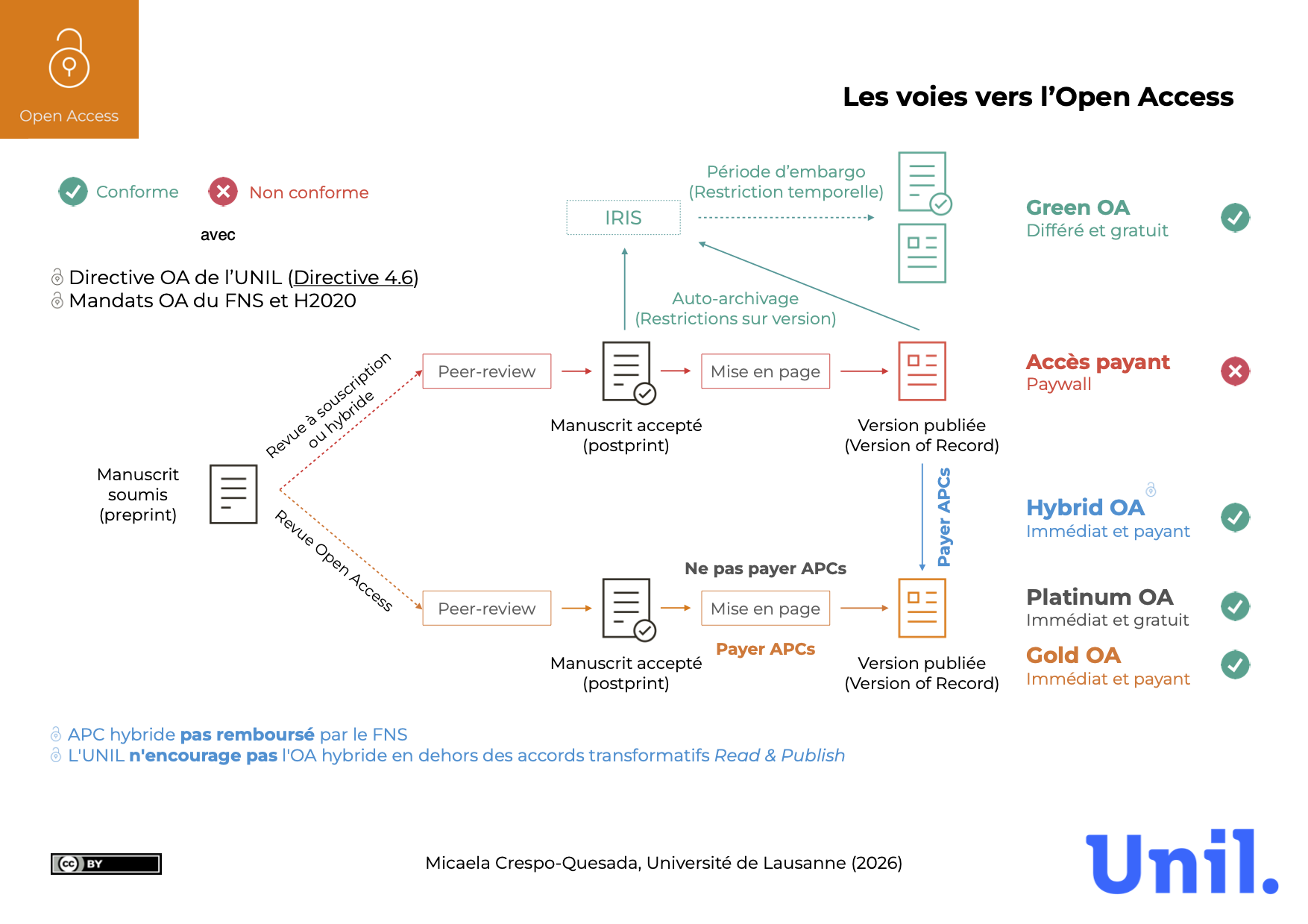
Publishing in a Gold Open Access journal (100% of the articles are OA) is the Gold route to Open Access (Gold OA). Works published via the Gold route are immediately accessible and are generally protected by an open licence such as Creative Commons.
However, there are other ways to publish in open access: the Diamond route (Diamond OA), the Green route (Green OA), and the Hybrid route (Hybrid OA).
The Diamond route (Diamond OA) is a model in which neither readers nor authors pay fees. Publication costs are covered by institutions, universities, libraries, or public funding. This model aims to guarantee equitable open access, without financial barriers for researchers, while ensuring the immediate dissemination of publications.
The Green route refers to the parallel publication (or self-archiving) of a version of the manuscript in an institutional repository. Open repositories may be institutional, such as our own SERVAL/IRIS, or discipline-based. Publication is often delayed (embargo period) and is only permitted for the author accepted manuscript (AAM), also known as the post-print. This is the manuscript accepted for publication (after peer review) but before any typesetting by the publisher. There is no additional cost for researchers following this route.
The Hybrid route (Hybrid OA) concerns subscription journals that offer the possibility of making certain articles open access upon payment of publication fees. In this model, a single journal may contain both restricted-access and open-access articles. Although this option allows immediate access to the relevant articles, it is criticised for the risk of "double-dipping."
Below you can find a diagram showing the routes to Open Access.
An Open Access journal has invited me to publish. How do I know if it is a reputable journal?
With the rapid growth of OA, "parasitic" or "predatory" OA journals exploit the author-pays model for their own benefit. Authors, typically solicited by email, are invited to submit articles that are systematically accepted in exchange for publication fees or APCs, regardless of the scientific quality of the work submitted. It should be noted that this problem only arises for Gold OA journals.
Jeffrey Beall, of the University of Colorado, created a site in 2008, scholarlyoa.com, which was closed in January 2017 and contained a list of potentially predatory journals based on 52 criteria. This list was used as a standard until its disappearance. An archived version is still available, and other sites have tried to fill the gap. It is also possible to consult the DOAJ to assess the credibility of an OA journal.
An intersectoral initiative, Think. Check. Submit., offers a simple checklist to help researchers evaluate the reliability of a journal or publisher. It is a particularly useful tool for avoiding predatory journals.
Another relevant resource is Compass to Publish, developed by the University of Liège. This interactive tool allows you to evaluate a journal by answering a series of structured questions (transparency, editorial board, peer review process, etc.) and provides clear decision-making guidance for researchers.
In practice, certain warning signs should raise attention: persistent solicitations, abnormally short publication timelines, lack of transparency about fees, a questionable editorial board, or absence of indexing in recognised databases. Conversely, a reputable journal provides clear information about its evaluation process, editorial policies, and any fees.
Can I publish a monograph in Open Access?
Yes.
Although OA for journal articles is well developed, OA for monographs is a nascent area and practices are far less standardised. However, a growing number of publishers allow the digital version of a book to be published in OA at the time of publication (Gold OA). The Directory of Open Access Books (DOAB) is a list of peer-reviewed academic books. OpenEdition is another platform primarily for French-language books. Both are excellent sources for finding publishers that already publish in Open Access. Publication costs for Open Access books are funded by the SNSF for all researchers in Switzerland.
It is also possible to publish books in Open Access via the Green route (Green OA), i.e. self-archiving of the manuscript with opening after an embargo. In this case, researchers must negotiate with publishers on a case-by-case basis.
Do Open Access mandates undermine my academic freedom?
The Encyclopaedia Britannica defines academic freedom as "the freedom of teachers and students to teach, study, and pursue knowledge and research without unreasonable interference or restriction from law, institutional regulations, or public pressure. Its basic elements include the freedom to study any topic that arouses intellectual interest, to present findings to students, colleagues, and others, to publish data and conclusions without control or censorship, and to teach in the manner one considers professionally appropriate."
From this perspective, Open Access mandates that allow for a combination of Open Access routes should not limit the academic freedom of researchers.
Indeed, by permitting both routes, researchers can choose the most appropriate dissemination channel for their work and then follow the necessary route to publish it in open access. Gold OA allows immediate open publication in OA journals and books, while Green OA allows deferred parallel publication of the article in a subscription journal and the author's manuscript (or post-print) in an institutional repository.
Can I deposit my old publications in SERVAL?
In principle, yes, but you must first check which rights you've transfered to your editor.
Use this checklist to know where to find this information and to know if and how the deposit is possible.
2. Diamond Open Access
What is the Diamond route?
The Diamond route refers to a model of immediate Open Access publication with no publication fees and no subscription fees.
How can the Diamond route operate without publication or reading fees?
Journals and publishing platforms that operate according to the Diamond model are mostly funded or subsidised by non-commercial sponsors — universities, learned societies, libraries, etc. — and allow authors to retain their copyright through the use of open Creative Commons licences.
Increasingly, these journals benefit from library support to ensure their sustainability. The Cantonal and University Library of Lausanne (BCUL), in collaboration with the University of Lausanne and the University Library of Medicine, has established a Diamond fund to support journals and platforms deemed important to the communities served by these institutions (see details on the BCUL Diamond Fund page).
When an author from the University of Lausanne publishes in a Diamond journal, they indirectly contribute to its support, since it will benefit from financial backing from the BCUL.
How can I tell if a journal follows the Diamond Open Access model, or which journals follow it?
The Directory of Open Access Journals (DOAJ) lists many Open Access journals, including those following the Diamond model. By searching for the term "no fees" and applying the "Without fees" filter, it is possible to obtain a list of journals that charge no publication fees.
Through its Diamond Fund, the Cantonal and University Library of Lausanne highlights, in its thematic selections, journals that have published researchers from the institutions it serves.
Can a book be published in Open Access via the Diamond route?
Publishing a book in Open Access via the Diamond route is rarer than for journals. However, some publishers work with the Open Edition infrastructure for the open access publication of their books.
The list can be found on the Open Edition platform publishers page.
3. Gold Open Access
What is the Gold route (Gold OA)?
The Gold route (Gold OA) refers to articles that are freely accessible immediately at the time of publication.
This is possible either through Open Access journals or with the publisher's agreement for books.
- The Directory of OA Journals (DOAJ) lists the various Gold OA journals that meet scholarly publishing standards;
- The Directory of Open Access Books (DOAB) lists academic books. OpenEdition is another platform for Open Access books, primarily in French. Both are excellent sources for identifying publishers that already publish in Open Access.
Works published in Open Access are often protected by an open Creative Commons licence.
Scientific publishing is not free. The Gold route shifts costs from the reader to the author. Gold OA is therefore an "author-pays" model and often involves the payment of article processing charges (APC) for articles, and book processing charges (BPC) for books. APC and BPC fees for purely Gold OA publications arising from research projects it funds are covered by the SNSF and, according to certain criteria, may be covered by UNIL's Gold Open Access Fund.
What should I do if there is no Gold Open Access journal in my field?
The Gold route has developed considerably in recent years; however, you may not find a suitable journal in which to publish your results. In that case, you will need to explore other publication routes and choose a title of interest that will allow you to publish via either the Hybrid route or the Green route.
The SNSF primarily requires publication via the Gold route and tolerates the Green route if there is no embargo on the dissemination of the manuscript. UNIL does not impose any particular publication route — all are accepted — and recommends publishing in Open Access whenever possible.
Do all Open Access journals charge Article Processing Charges (APC)?
No.
Many OA journals do not charge publication fees (APCs). Indeed, 74% of journals listed in the Directory of Open Access Journals, DOAJ, do not charge APCs.
The publishing process is not without cost. Gold OA journals that do not charge APCs rely on funding from universities, academies, funders, libraries, etc., to operate. These are subsidised OA journals and constitute the Diamond OA model, in which articles are free both for the author and for the reader.
Why do we have to pay Article Processing Charges (APC)?
Gold Open Access journals fund themselves through advertising and through the fees associated with publishing articles (APCs). These charges vary from €1,000 to more than €6,000 per article. There are no standard rules; each journal or publisher determines the amount it considers appropriate.
Through Read & Publish agreements, it may be possible to obtain either a reduction on the APC — which generally allows the amount accepted by the Gold OA Fund (FGOA) to be reached — or full coverage, meaning no cost to the author.
If the fees exceed the amount accepted by the FGOA and there is no agreement for full coverage, the cost of the publication falls to the author or their department.
Since the Gold route is the preferred route for the SNSF, the SNSF covers Gold route publications according to its own criteria.
4. Green Open Access
What is the Green route (Green OA)?
The Green route is the publication model used when there is no publishing agreement with a hybrid journal, or when a subscription journal offers no Open Access publication option at all. Publishing in Open Access in this type of journal implies paying both for the publication and for access to the rest of the journal. This is called "double dipping" and is not tolerated by the institution.
This type of publication consists, according to the publisher's criteria, of sharing the final version of one's manuscript (peer-reviewed, but before typesetting by the journal) in an open repository such as your institutional repository IRIS or a discipline-based repository. This is also referred to as self-archiving.
The final accepted version of an article is called either the Author Accepted Manuscript (AAM) or the post-print.
The Open Policy Finder website lists the conditions set by a large number of journals for sharing this manuscript.
Since the final version of your article will be published in a closed format on the publisher's website, Green route publication cannot be considered genuine Open Access. The content of your article will certainly be accessible via repositories, but copyright generally remains with the journal's publisher under standard copyright. This type of publication therefore does not comply with current Open Access policies (author rights retention, CC-BY licence).
How can I follow the Green route (Green OA) at UNIL?
If the journal of your choice is not covered by a Read and Publish agreement and it is a subscription journal (with or without an Open Access option), you should opt for the Green route. To do this, you will need to share your article as a PDF in IRIS, our institutional repository.
Once your PDF has been uploaded to the reference for your article on IRIS, you will need to indicate the licence, any applicable embargo, and the other constraints imposed by the publisher via a dialogue box (edit icon).
Does self-archiving (Green OA) violate copyright?
No, provided you comply with the conditions imposed on your Author Accepted Manuscript (AAM) by the publisher (embargo, licence for the manuscript, etc.), you are not infringing copyright.
The Open Policy Finder lists a large number of journals and details the sharing conditions for each version of the article. Mir@bel is a similar service for French-language publishers and journals.
What is an embargo period?
An embargo period is a period required by a journal's publisher during which the accepted version of an article may be deposited in an institutional repository but cannot yet be made publicly accessible.
The principle is that the journal wants to ensure that the article is primarily read through the journal itself, and therefore via individual or institutional subscription.
The publisher authorises the release of the Author Accepted Manuscript in the institutional repository after a defined period running from the date of publication: 6, 12, or 18 months after that date. Some journals allow immediate access from the date of publication and therefore do not apply an embargo to those publications.
NB: The SNSF tolerates Green route publication only for articles that have no embargo.
What is IRIS?
IRIS is our research information system and serves as the institutional repository for UNIL publications.
The referencing and deposit of a version of scientific publications produced as part of research at UNIL is mandatory for the entire UNIL research community.
Since IRIS is harvested by major search engines, it is a very useful tool for increasing the visibility of the institution's scientific output and its researchers.
It has a dual purpose:
- On one hand, it enables long-term archiving of the institution's scientific output.
- On the other hand, it maximises researcher visibility, in particular by enabling publication via the Green route (Green Open Access).
5. Hybrid Open Access
What is the Hybrid route?
The Hybrid route refers to the immediate Open Access publication of an article within a subscription journal. In this model, some articles are made freely accessible upon payment of Article Processing Charges (APC), while the rest remain available only to subscribers.
Please note that some hybrid journals offer to publish articles as Gold Open Access. This is a misuse of terminology on their part. Articles in hybrid journals are in Open Access, while the Gold route is a separate mode of publication.
Do all publishers of hybrid journals require payment of Article Processing Charges (APC)?
To publish in Open Access in subscription journals, payment of publication fees (APC) is generally required. However, some publishers — such as Annual Reviews — offer alternative models. Under the "Subscribe to Open" model, content is made freely accessible when a sufficient number of libraries maintain their journal subscription. In that case, no publication fee is charged to authors.
Special "Read & Publish" agreements have been concluded with publishers, allowing articles to be published in Open Access with no fees, or at a discount, in certain hybrid journals. The list of agreements can be found on the "Open Access Institutional Agreements" page.
There is no institutional agreement with the publisher of the journal in which I wish to publish. How can I still comply with Open Access mandates?
It is possible to publish in a closed format (copyright assigned to the publisher) and follow the Green route if no funding is available for Open Access publication in a hybrid journal.
6. No Deal situation
This FAQ aims to answer the main questions related to the current No Deal situation between Swiss universities and certain major scientific publishers, notably Springer Nature and Sage. Following national negotiations to obtain “Read & Publish” agreements—allowing both access to journals and Open Access publication—the proposed terms were not deemed to be in line with the objectives set by swissuniversities. As a result, new temporary practices for publishing, accessing articles, and editorial evaluation are now in place. The answers below explain what this means in practical terms for UNIL researchers and what alternatives to prioritize during this period.
What is a Read & Publish agreement and why are we in a No Deal situation with Springer/Sage?
A Read and Publish agreement is an agreement with publishers that not only guarantees access to scientific publications (Read part) but also allows open publication for researchers (Publish part). These agreements are negotiated at the Swiss level with major scientific journal publishers (Elsevier, Wiley, Springer Nature, Sage, Taylor and Francis, Ovid, Oxford University Press, Cambridge University Press, Karger). The annual costs cover access to journals and publication fees for a limited or unlimited number of articles, depending on the agreement, in a single payment.
The terms offered by these publishers did not meet the requirements set (see below), and we are therefore currently in a no-deal situation.
Who negotiates Read & Publish agreements and how are decisions made?
Read and Publish licenses are negotiated by the Consortium of Swiss Academic Libraries (CSAL). Acting on behalf of swissuniversities, the Consortium represents more than 40 Swiss universities and institutions. This collective representation strengthens Switzerland's position in negotiations with scientific publishers.
Decision-making processes vary depending on the publisher:
- For Elsevier, Springer Nature, and Wiley (the “Big Deals”): The negotiation objectives are defined by the Open Science Delegation (DelOS) and then approved by the members of swissuniversities. By signing, the universities, institutions, and libraries concerned support these objectives and undertake not to conduct parallel negotiations. The results and experiences of previous negotiations are regularly discussed between the various stakeholders (universities, libraries, institutions). The final decision on whether to accept the agreement is taken by the Open Science Delegation (DelOS).
- For other publishers: Negotiations are based on the same principles and objectives as those for Big Deals. However, decisions are made directly by the libraries and institutions concerned.
Can I still publish with Sage/Springer Nature?
In order to support the national negotiating team and in accordance with the recommendations of swissuniversities, researchers are invited to temporarily refrain from publishing in Springer Nature/Sage journals and to favor alternatives, with the support of libraries to guide them.
Researchers are encouraged to prioritize publishing their articles in journals included/covered by other agreements. Please consult the complete list of agreements with OA components.
When publication with these publishers is still desired or necessary, the conditions will depend on the type of journal:
- Gold OA journal (publishes only OA articles): Neither UNIL, the libraries, nor the SNSF will cover gold APCs during a no-deal period for articles submitted after the contract has ended.
- Hybrid journal (publishes both closed and OA articles simultaneously): Neither UNIL, the libraries, nor the SNSF will cover hybrid APCs during a no-deal period. The university also recommends that its researchers do not pay publication fees individually. The preferred route is the green route: depositing and sharing the publication in IRIS, in accordance with Open Access requirements.
- For gold or hybrid journals, it is also possible to request the transfer of the corresponding author position to a co-author affiliated with an institution that has an agreement in place.
Is the green route sufficient?
Yes, the green route is a legitimate Open Access route, both for UNIL and for many funders, subject to certain conditions.
- Articles initially published in closed access, provided that access to the publication is possible without embargo. However, if the article is the result of a project submitted to the SNSF before 1 January 2023, a six-month embargo is permitted. Exceptions may be granted by the SNSF provided that it can be proven that an attempt was made to ask the publisher to lift the embargo and that the publisher refused.
- Final manuscripts, i.e. the latest version of the article incorporating all the changes requested by the peer reviewers, but before layout by the publisher. This version must be distributed under a CC-BY licence.
It is important to note that archiving on personal pages or academic social networks (such as ResearchGate or Academia) does not guarantee long-term archiving, access without an account, or good visibility. This type of archiving is therefore not considered Open Access.
What happens if I have submitted my article to an Open Access publisher and it is accepted after the No Deal situation begins?
The situation depends on the type of journal and the timing of the submission and acceptance of the article.
- If the article was submitted to a Gold journal:
- Coverage of publication charges (APCs) depends on the funding available at the time of acceptance (institutional funds, SNSF funds, funding by the department or faculty).
- It is recommended that you contact the publication support service at Unil (open.access@unil.ch) and CHUV/Unisanté (open.access@chuv.ch) as soon as possible to assess the available options (change of journal, green road deposit, publication deadlines, etc.).
- In the case of a hybrid journal:
- Neither Unil, the libraries nor the SNSF will cover hybrid APCs during a no-deal period. The university also recommends that its researchers do not pay publication fees individually. The preferred route is the green route: depositing and sharing the publication in IRIS, in accordance with Open Access requirements.
Case-by-case assessment
Aware that these situations can be problematic for researchers, UNIL and BCUL will examine specific cases on a case-by-case basis and will seek, as far as possible, appropriate solutions, taking into account the context of the submission, publishers' constraints and Open Access requirements.
Please note that Unil will not cover Gold OA costs for articles submitted after the start of the situation without a contract.
Can I continue to peer review for these publishers or serve on the editorial boards of their journals?
Scientific editors involved in journals published by these publishing houses are invited to critically reflect on their editorial commitment in the current context. While it is recognized that scientific editors generally have very limited room for maneuver with regard to the strategic decisions of publishing houses, certain forms of positioning are nevertheless possible.
In particular, when deemed relevant and feasible, editors may consider collectively or individually communicating their concerns to the journals concerned, for example by temporarily suspending their editorial activities for the duration of a no-deal scenario and explaining the reasons for this decision to the operational editorial teams.
As for peer review activities for journals published by these publishers, they should be critically reevaluated in the current context and should not be considered a priority.
How can I access articles in a No Deal situation?
We recommend searching for articles in their Open Access version, which is made easier by installing search “buttons” (Unpaywall or Core Discovery) in Firefox, Chrome or Edge browsers, searching for versions available on institutional platforms (e.g., IRIS), or requesting a copy directly from the author.
The BCUL and the various faculty libraries are also available to assist you in your research through the following services:
- Print subscriptions and electronic access until the end of 2025
- BCUL interlibrary loan (ILL) service
- The information desk at your BCUL site
- The BCUL question and answer service
- The BiUM article delivery service (see conditions at bium.ch)
- The BiUM information service
Can I subscribe to one or more individual journals/articles?
Both are strongly discouraged:
- Paying for an article directly from the publisher is detrimental to the successful outcome of negotiations, as it represents a financial flow to the publisher. In addition, the price of articles is often very high.
- Paying for an individual subscription is detrimental to the successful outcome of negotiations, as it represents a financial flow to the publisher.
7. Gradual phase-out of Read & Publish
This FAQ answers questions related to UNIL's decision to gradually phase out “Read & Publish” licenses with certain publishers. Here you will find information, which will be updated as it becomes available, on the phase-out schedule, the reasons for this change, alternatives for accessing publications, and options for publishing in open access.
What is a Read & Publish agreement and what is it for?
A Read and Publish agreement is an agreement with publishers that not only guarantees access to scientific publications (Read part) but also allows open publication for researchers (Publish part). These agreements are negotiated at the Swiss level with major scientific journal publishers (Elsevier, Wiley, Springer Nature, Sage, Taylor and Francis, Ovid, Oxford University Press, Cambridge University Press, Karger). The annual costs cover access to journals and publication fees for a limited or unlimited number of articles, depending on the agreement, in a single payment.
These agreements were designed primarily to put an end to double dipping, whereby institutions paid twice for hybrid open access journals: once for access to the journal as a whole and once for publication. Read & Publish agreements are temporary in nature and are intended to initiate and continue the transition from Hybrid Open Access to Full Gold Open Access, with the aim of achieving a global shift to a sustainable, fully open access publishing model. However, despite this vision, the transition to this new paradigm remains slow, as highlighted by cOAlition-S, among others.
Who negotiates Read & Publish agreements and how are decisions made?
Read and Publish licenses are negotiated by the Consortium of Swiss Academic Libraries (CSAL). Acting on behalf of swissuniversities, the Consortium represents more than 40 Swiss universities and institutions. This collective representation strengthens Switzerland's position in negotiations with scientific publishers.
Decision-making processes vary depending on the publisher:
- For Elsevier, Springer Nature, and Wiley (the “Big Deals”): The negotiation objectives are defined by the Open Science Delegation (DelOS) and then approved by the members of swissuniversities. By signing, the universities, institutions, and libraries concerned support these objectives and undertake not to conduct parallel negotiations. The results and experiences of previous negotiations are regularly discussed between the various stakeholders (universities, libraries, institutions). The final decision on whether to accept the agreement is taken by the Open Science Delegation (DelOS).
- For other publishers: Negotiations are based on the same principles and objectives as those for Big Deals. Negotiations are conducted by Swissuniversities and agreements are concluded in consultation with the libraries and institutions concerned.
Who finances the Read & Publish agreements for UNIL?
Under the regulations governing the Acquisition Fund for the University of Lausanne of the Canton of Vaud, the Cantonal and University Library of Lausanne (BCUL) is responsible for building the collections necessary for teaching and research at the University of Lausanne. As such, the University of Lausanne allocates an annual budget to the BCUL for this purpose.
The University of Lausanne therefore finances these agreements, while the BCUL is responsible for their financial and administrative management.
How much does this type of agreement cost?
Several agreements are subject to confidentiality clauses, particularly with regard to their costs. Details, if they can be disclosed, are available on the Swiss Library Consortium (CSAL) agreements website.
In 2025, 63% of the University of Lausanne's subsidy to the Cantonal and University Library of Lausanne (BCUL) for electronic resources was spent on products from ten major publishers, while only 8% was invested in Diamond and Gold models, and 29% in nearly 300 other types of products (specialized databases, journals from small publishers, and ebooks) . Prices are increasing by 5 to 10% each year, feeding publishers' profit margins of up to 40%.
Why is UNIL withdrawing from Read & Publish licenses?
The University of Lausanne's decision to gradually withdraw from Read & Publish licenses is part of the evolution of its institutional policy on Open Access and its increased alignment with the Swiss national Open Access strategy, revised in 2024.
This strategy aims in particular to reduce the scientific system's dependence on a small number of large commercial publishers, promote academic quality and bibliodiversity, and ensure the long-term financial sustainability of the scientific publishing model.
However, despite the progress made possible by Read & Publish agreements, the current model is now showing its limitations. In 2025, nearly two-thirds of the subsidy allocated by UNIL to BCUL for electronic resources was spent on products from ten major publishers, to the detriment of a wide range of other resources essential to teaching and research (specialized databases, journals from small publishers, electronic books). Furthermore, the costs of these licenses are rising steadily, at a rate of 5 to 10% per year, which calls into question their sustainability in the medium term.
Continuing with this model would ultimately lead to a weakening of the diversity of collections and increased dependence on a few dominant players in the scientific publishing market, without fully achieving the objectives of Open Access.
How can I access articles without Read & Publish agreements?
At this stage, the precise terms and conditions for exiting Read & Publish agreements have not yet been finalized. They will depend in particular on the contractual conditions specific to each publisher and the results of the analyses currently being conducted by BCUL, in collaboration with the faculties.
It is therefore likely that the conditions and alternatives will vary from one publisher to another. Specific information for each publisher will be published in this wiki when it becomes available.
In the event that read access is restricted or interrupted, there are several proven and complementary solutions that allow you to continue accessing the articles you need for your research:
We therefore recommend searching for articles in their Open Access version, which is made easier by installing search “buttons” (Unpaywall or Core Discovery) in Firefox, Chrome or Edge browsers, searching for versions available on institutional platforms (e.g., IRIS), or requesting a copy directly from the author.
The BCUL and the various faculty libraries are also available to assist you in your research through the following services:
- Print subscriptions and electronic access until the end of 2025
- BCUL interlibrary loan (ILL) service
- The information desk at your BCUL site
- The BCUL question and answer service
- The BiUM article delivery service (see conditions at bium.ch)
- The BiUM information service
How can I publish in OA without Read & Publish agreements?
Open Access publishing is not limited to Read & Publish agreements. Today, there are a variety of Open Access routes, recognized by UNIL and major funding agencies, that allow research results to continue to be freely accessible.
These include:
- The green route (depositing and sharing in IRIS);
- The Gold route (publication in fully Open Access journals, with payment of APCs);
- The Diamond route (Open Access journals with no publication fees for authors).
As with the “Read” component, the terms of the “Publish” component following the release of the Read & Publish agreements have not yet been finalized. They will depend on publishers, contractual frameworks, and decisions made at the institutional and national levels.
More detailed information will be provided as analyses and negotiations progress and will be available on this wiki.
In the meantime, researchers are encouraged to favor recognized Open Access routes, particularly the green route, and to take advantage of the support offered by the publication support service at Unil (open.access@unil.ch) and CHUV/Unisanté (open.access@chuv.ch).
Is the green route sufficient?
Yes, the green route is a legitimate Open Access route, both for UNIL and for many funding bodies, subject to certain conditions.
- Articles initially published in closed access, provided that access to the publication is possible without embargo. However, if the article is the result of a project submitted to the SNSF before January 1, 2023, a six-month embargo is permitted.
- Final manuscripts, i.e., the latest version of the article incorporating all changes requested by peers, but before layout by the publisher. This version must be distributed under a CC-BY license.
It is important to note that archiving on personal pages or academic social networks (such as ResearchGate or Academia) does not guarantee long-term archiving, access without an account, or good visibility. This type of archiving is therefore not considered Open Access.
8. Instructions in the absence of licenses
9. OA deals
Complete list of agreements with OA component
“Read & Publish” agreements have been made with the publishers listed below, allowing for the publication of articles at no cost, or at a discount, in certain Hybrid OA and Gold OA journals. A gradual phase-out of these licenses is currently underway at UNIL.
SNSF-funded researchers: All Gold OA fees (books, book chapters and articles) of SNSF-funded researchers at Unil are covered by the SNSF, with the exception of the agreements listed below which also include Gold OA journals.
Researchers without an SNSF grant: Gold OA fees for books are also covered by the SNSF until 31 December 2026. For Gold OA articles not covered by Read & Publish agreements, or chapters or books in Gold OA, Unil/CHUV/Unisanté authors are invited to consult the eligibility conditions of their Unil Gold Open Access Fund.
When these options are not applicable, Unil generally encourages Green OA (self-archiving in IRIS). For example, if the annual quotas for publications linked to some of the agreements listed below are exhausted, Unil/CHUV authors are advised to favor Green OA when publishing in Hybrid OA journals.
Total or Partial APC Subsidy
Conditions to be met in all cases:
- The corresponding author of the submitted article must be a member of Unil/CHUV/Unisanté.
- The research leading to the publication must have been conducted at Unil.
-
Former researchers who are no longer affiliated with Unil may be eligible for coverage of their publication fees, provided that the research leading to the publication was conducted at Unil and the work was submitted within one year of the end of their affiliation.
- The affiliation details in the article must clearly indicate the author's affiliation to Unil/CHUV/Unisanté. Please follow the indications in Directive 4.3 regarding author affiliation.
- Ideally, the author will use his/her ORCID ID .
- Whenever possible, use your @unil, @chuv or @unisante email address to make the submission.
| Editor | Status | Quota | Conditions | More information |
|
Annual Reviews
2024-2026 |
ACTIVE | Unlimited |
"Subscribe to Open” (S2O) publication model: article immediately available with no access barrier and no cost to the author. |
|
|
BMJ
2025-2026 |
ACTIVE |
Limited |
Full support for APCs in hybrid journals |
Eligible Article Types Research Articles
APCs for articles published in Gold journals can be covered by the Gold OA Fund, provided they meet the eligibility criteria. NB: BMJ now requires the corresponding author to provide a VAT number in order to issue the APC invoice. Please contact the finance department of your faculty or institute to find out which number to provide. |
|
Cambridge University Press
2024-2026 |
ACTIVE |
Unlimited |
Full APC coverage |
Eligible Article Types Research Articles |
| Cogitatio |
ACTIVE |
Unlimited |
Full APC coverage |
|
| De Gruyter | ACTIVE | Unlimited |
90% APC discount in hybrid journals which are part of the Unil license
The 10% not taken into account cannot be financed through the Gold OA Fund. |
Please write to |
|
Elsevier
2024-2028 |
ACTIVE |
Unlimited |
Full APC coverage in the following portfolios: Core, Cell Press, The Lancet. |
Eligible Article Types Case Report |
|
Karger
2026-2028 |
ACTIVE |
Unlimited |
Full APC coverage |
|
|
LWW
2025-2027 |
ACTIVE
|
Limited |
Full APC coverage |
Title List |
| MDPI |
ACTIVE |
Unlimited |
20% APC discount |
APCs can be covered by the Gold OA Fund, provided they meet the eligibility criteria |
|
Nature Hybrid journals (Springer)
2026-2029 |
ACTIVE |
Limited |
Full APC coverage.
|
Attention: Nature Reviews and Scientific American do not offer Open Access options.
Eligible article types Original Paper
swissuniversities with the publisher Springer Nature on 10 June 2026. Articles accepted from 1 January 2026 onwards are covered; it will be possible to retroactively convert articles to open access in accordance with procedures to be announced in the summer of 2026. Important: for researchers funded by the SNSF, the SNSF affiliation must no longer be used; the affiliation must be Unil/CHUV/Unisanté. |
|
Oxford University Press
2025-2027 |
ACTIVE |
Unlimited |
Full support for APCs in hybrid journals in the OUP Full Collection.
10% APC discount in Gold OA journals |
APCs for articles published in Gold journals can be covered by the Gold OA Fund, provided they meet the eligibility criteria |
| PLOS |
ACTIVE |
Unlimited |
Full APC coverage |
If you want to publish under this license please refer these instructions for the following journals : PLOS ONE PLOS Computational Biology PLOS Pathogens PLOS Neglected Tropical Diseases PLOS Genetics PLOS Digital Health
For the following journals please refer the these instructions: PLOS Biology PLOS Medicine PLOS Sustainability and Transformation
APCs of journals not covered by the agreement can be submitted to the Gold OA Fund, provided they meet the eligibility criteria |
|
Presses Universitaires de Rennes (PUR) |
ACTIVE | 5 books per year |
The principal author or the scientific editor has to be affiliated with UNIL.
Grant of € 4,000 per copy (without images and less than 800,000 characters). |
UNIL representative on the PUR editorial board: Laurent Le Forestier Pierre-Henry Frangne, Director Editorial Department |
|
SAGE
2023-2025
2026: Please refer to this Unil news, as well as the on the Consortium of Swiss Academic Libraries' website. |
No agreement currently in place |
Unlimited |
Full APC coverage in Hybrid and Gold journals |
Eligible Article Types Original Research Papers |
|
Springer Gold journals (included Nature, BMC and Palgrave)
2026-2029 |
ACTIVE |
Limited |
Full APC coverage. |
Original Paper swissuniversities with the publisher Springer Nature on 10 June 2026. The agreement covers articles accepted from 10 June onwards. Important: for researchers funded by the SNSF, the SNSF affiliation must no longer be used; the affiliation must be Unil/CHUV/Unisanté. |
|
Springer Hybrid journals
2026-2029
|
ACTIVE
|
Unlimited |
Full APC coverage.
|
Original Paper
swissuniversities with the publisher Springer Nature on 10 June 2026. Articles accepted from 1 January 2026 onwards are covered; it will be possible to retroactively convert articles to open access in accordance with procedures to be announced in the summer of 2026. Important: for researchers funded by the SNSF, the SNSF affiliation must no longer be used; the affiliation must be Unil/CHUV/Unisanté. |
|
Taylor & Francis
2024-2027 |
ACTIVE |
Limited |
Full APC coverage |
Eligible Article Types Article Commentary |
|
Wiley
2025-2027
The 2026 quota for articles in Gold OA journals is exhausted. Therefore, APCs will no longer be covered through the Read & Publish agreement. Neither the FNS nor the Unil Gold Open Access Fund will take over funding for these publications. APCs in Gold OA journals will continue to benefit from a 15% discount. |
ACTIVE |
Limited
Quota 2026 articles in Gold OA journals is exhausted. |
Full APC coverage in Hybrid and Gold journals. |
Some hybrid journals will transition to Gold OA sometime in 2026. APCs for these journals will be covered, regardless of whether the quota for Gold articles has been exhausted.
Eligible Article Types Case Study |